
 In 30 Seconds




The previous article in this series recorded the three days of organised killing that followed Indira Gandhi’s assassination. This one records what came after the fires went out, because a pogrom does not end when the mobs disperse. It continues in relief camps, in widowhood, in courtrooms that open and close for forty years, and in a colony in West Delhi whose very name, the Widow Colony, is an indictment written into the city’s map.
The Camps and the Count
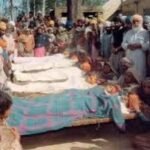
In the first days of November 1984, tens of thousands of Sikhs crowded into gurdwaras, schools, and hastily organised relief camps across Delhi. Volunteers, many of them Hindu neighbours who had sheltered Sikh families at real personal risk, a truth survivors themselves have always insisted be recorded alongside the horror, ran langars and compiled the first lists of the dead. Those lists, assembled by citizens’ groups because the state initially would not, became the foundation of the official Delhi toll of 2,733, a number most researchers regard as a floor rather than a ceiling once killings in Kanpur, Bokaro, and dozens of other cities are added.
Tilak Vihar: The Widow Colony
The state’s answer to mass widowhood was resettlement, and its emblem is Tilak Vihar in West Delhi, where hundreds of widowed families were allotted small flats. Journalists who have reported from the colony across four decades describe a community suspended in 1984: women who washed and stitched for a living after their men were burned, sons who grew up without fathers and, in documented numbers, fell to addiction in the 1990s and after, and walls of photographs of the dead in nearly every home. Compensation arrived in instalments across decades, enhanced by successive governments, and always calculated in a currency that cannot buy back a family.
Ten Commissions and Two Convictions of Consequence
The machinery of inquiry began almost immediately and continued for a generation: the Marwah inquiry halted midway, the Misra Commission of 1985 whose findings shielded more than they revealed in the judgment of most observers, and a succession of committees, Kapur Mittal, Jain Banerjee, Ahuja, Dhillon, Narula, Nanavati, each excavating a portion of the truth. The Nanavati Commission in 2005 recorded evidence against Congress figures and prompted a prime ministerial apology in Parliament, when Manmohan Singh, himself a Sikh, bowed his head before the nation for what had happened.
Criminal justice moved slower still. The Delhi High Court’s 2018 conviction of Sajjan Kumar, upheld as the court described the violence as a crime against humanity, and the earlier convictions in the Trilokpuri cases, stand as the exceptions that prove the rule. Most cases died with witnesses, evidence, or accused. The Special Investigation Team constituted in 2015 reopened dozens of files decades cold. For the women of Tilak Vihar, justice arrived, where it arrived at all, in their old age.
What Survival Teaches
The survivors’ forty year fight has changed India in ways the killers never intended. It built a jurisprudence, cited in later mass violence cases, that political patronage of murder can be judicially named. It forced the word pogrom into the national vocabulary. It created a generation of Sikh lawyers, journalists, and activists, many of them children of the camps, who made remembrance a profession. And it kept a moral question alive that every subsequent government has had to answer or evade: what does a republic owe the citizens it failed to protect from itself?
Punjab’s insurgency drew recruits from November’s orphans, and the state’s counterinsurgency created new widows in turn, a symmetry of grief this series will keep returning to. But the survivors of 1984 themselves, overwhelmingly, chose courts over guns, testimony over vengeance, four decades of affidavits over a single night of retaliation. That choice, made by the people with the greatest claim to rage, remains the most under honoured act of citizenship in modern Indian history, and it deserves to be recorded as such.
Related Reading
- The Killing Fields of Majha: Tarn Taran and Amritsar in the Late 1980s
- The Bus Massacres: When the Militancy Turned Its Guns on Passengers
- The Air India Kanishka Bombing: Terror Crosses the Ocean
Official context: Readers can compare this story with public information from India.gov.in.
The Descent
Part 1 of 10 in this chapter.