
 In 30 Seconds




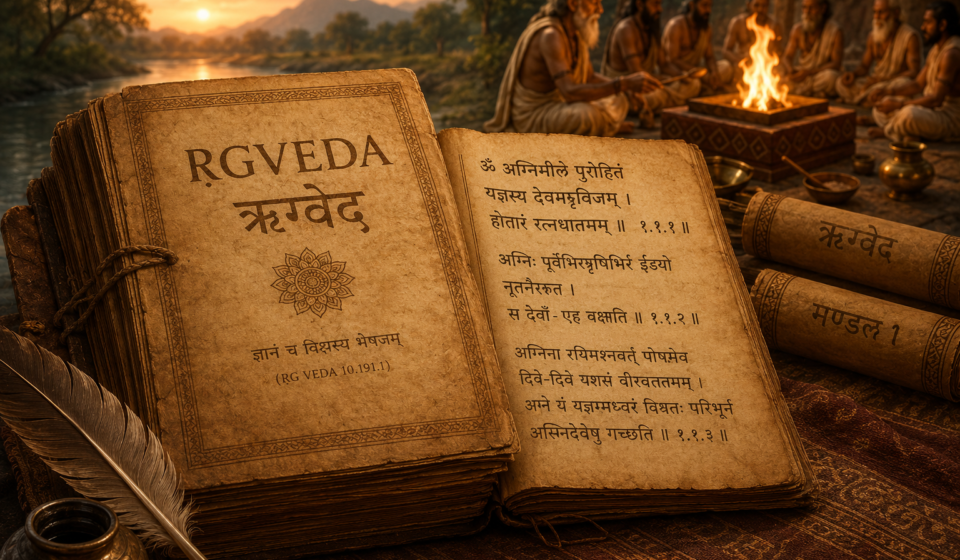
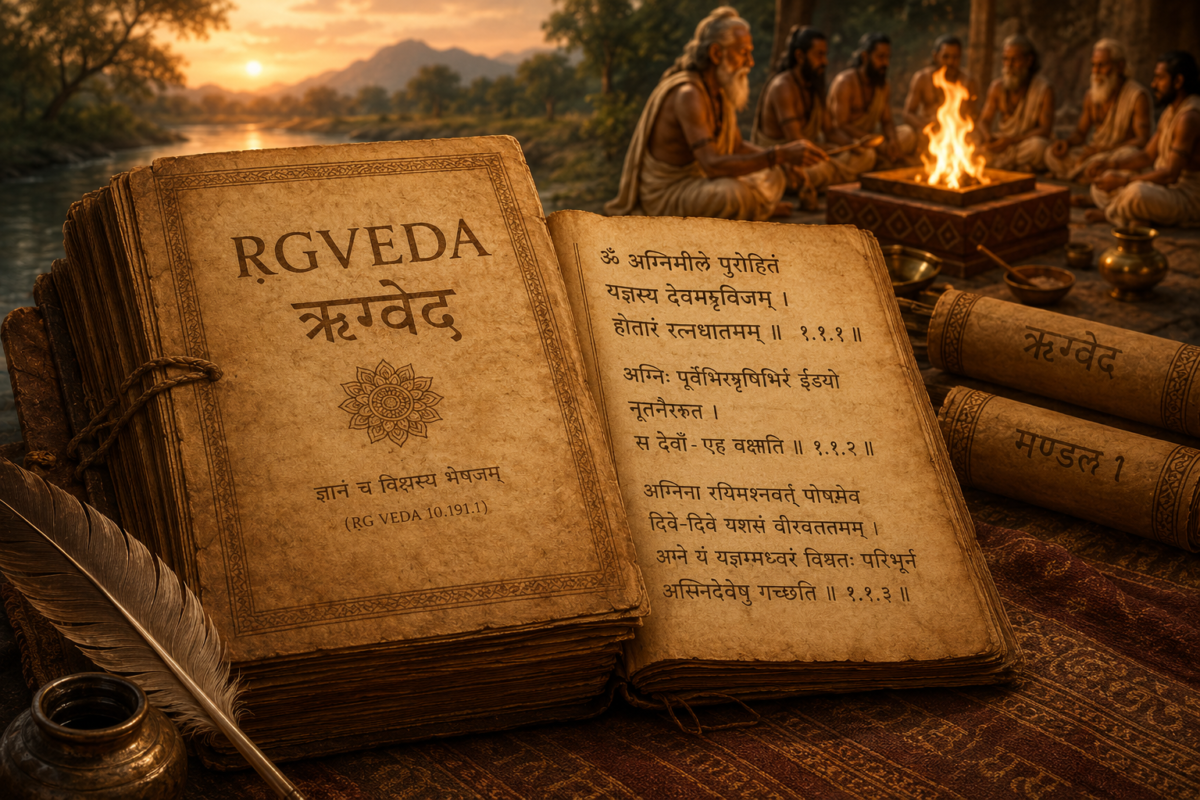
Imagine a world lit only by fire and starlight, where the boundary between the sacred and the everyday barely existed, where a family’s wealth was measured in cattle and a poet’s words could summon rain or victory in battle. This is the world preserved in the Rig Veda, the oldest of the four Vedas and among the oldest religious texts still recited anywhere on earth. Composed in early Sanskrit over several centuries, likely beginning around 1500 BCE, its more than one thousand hymns offer us an extraordinary window into the earliest chapter of what would become Indian civilization.
The Rig Veda is not a history book in the conventional sense. It is a collection of hymns addressed to a pantheon of gods, praising forces of nature given divine personality. Agni, the god of fire, served as messenger between humans and the divine, carrying offerings upward through smoke and flame. Indra, wielder of thunder, was celebrated as a warrior god who battled the demon Vritra to release the life giving waters. Varuna watched over cosmic order and moral truth, while Surya, the sun, journeyed across the sky each day in his chariot. Through these hymns we glimpse a people deeply attuned to the rhythms of nature, dependent on rain for their crops and cattle, and anxious to maintain favor with the forces that governed their survival.
Society in this Vedic world revolved around the tribe, called the jana, led by a chieftain known as a rajan who was more a first among equals and war leader than an absolute monarch in the later imperial sense. Assemblies called the sabha and samiti provided spaces for community discussion and decision making, suggesting elements of collective governance existed even in this early period. Cattle were the primary measure of wealth, so central to daily life that wars were often fought over herds, and the word for war itself, gavishti, literally translates to a desire for cows.
Family life centered on the household fire, tended carefully as a sacred trust passed through generations. Women appear in the hymns with more visibility and agency than in some later periods of Indian history, with several hymns attributed to female composers such as Lopamudra and Ghosha. Marriage hymns describe elaborate rituals meant to bless a union with prosperity and children, while funeral hymns reveal beliefs in an afterlife and the importance of proper cremation rites, practices whose echoes still shape Hindu tradition today.
The Rig Veda also captures a society in geographic transition, describing rivers, mountains and unfamiliar peoples as its composers moved across the landscape of what is now Punjab and the surrounding regions. References to battles, alliances and the gradual settlement of new territories suggest a dynamic period of expansion and cultural formation rather than a static, unchanging world. Debates continue over whether this reflects newcomers settling a fresh landscape or established communities adapting to internal social and political change, but either way the hymns pulse with the energy of a civilization actively defining itself.
What makes the Rig Veda extraordinary is not simply its antiquity but its survival. Passed down through an unbroken oral tradition using techniques of memorization so precise that scholars can still verify pronunciation patterns thousands of years later, these hymns represent one of humanity’s most remarkable achievements in cultural preservation. To read the Rig Veda today is to hear, almost unfiltered, the voice of people who lived, feared, celebrated and wondered about the universe on the same soil that modern India now calls home, a thread of continuity stretching across five millennia of human experience.
Related Reading
- After Ashoka: The Slow Twilight of the Mauryan Dynasty
- The Aryan Question: What Genetics Now Tells Us
- Vedic Society: Caste, Family and Faith in Early India
Official context: Readers can compare this story with public information from Archaeological Survey of India.
Ancient India - Batch 1
Part 4 of 20 in this chapter.