 In 30 Seconds




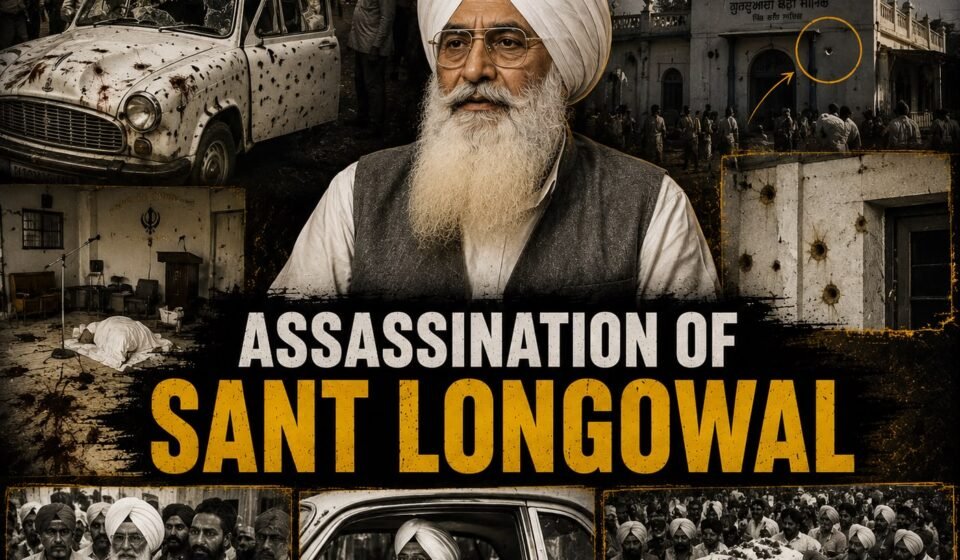
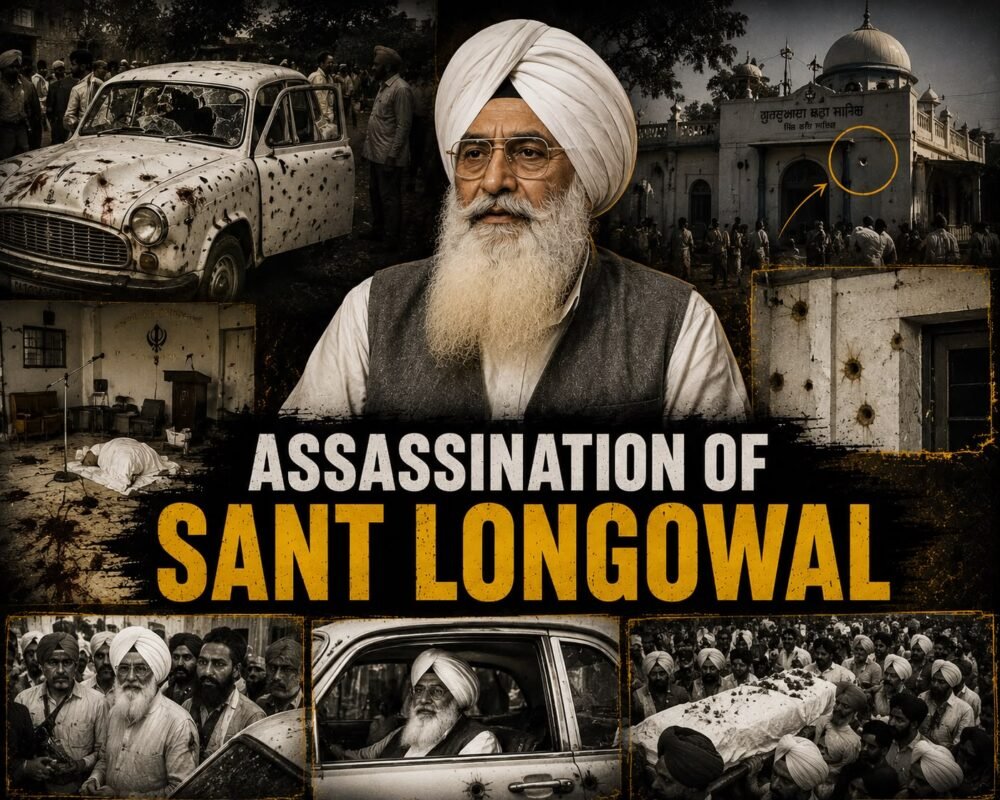
On the evening of August 20, 1985, Sant Harchand Singh Longowal sat before a congregation at a gurdwara in Sherpur village in Sangrur district, doing what he had done all his life, speaking to ordinary Sikhs about the affairs of the Panth. Twenty six days earlier he had signed the Punjab Accord with Rajiv Gandhi. Two young men in the congregation rose and shot him. He died that night, aged fifty three, and with him died the best organised chance of an early peace in Punjab.
The Man
Longowal was a religious figure before he was a political one, a sant in the rural Malwa tradition, trained in scripture, austere, and personally gentle by the testimony of nearly everyone who dealt with him, including his adversaries. He had risen to lead the Akali Dal through the Dharam Yudh Morcha, the agitation whose custody he shared, uneasily and then bitterly, with Bhindranwale. The two men occupied the same complex in Amritsar through 1983 and 1984 as rivals for the soul of the movement, the sant of negotiation and the sant of confrontation. Operation Blue Star swept up Longowal too; he was taken into custody during the assault and spent months in detention, emerging in 1985 into a Punjab traumatised by June and November.
The Decision to Sign
What Longowal did next required a courage that is easy to understate. Against the advice of colleagues who feared exactly what happened, he chose settlement. His reasoning, as recorded in contemporary interviews, was that the community was bleeding, that the demands could be won at the table, and that someone with religious standing had to legitimise peace or the gun would legitimise itself. He toured Punjab after the signing, defending the accord village by village, conceding its imperfections, and asking his people to choose the living over the dead. The crowds he drew suggested many were ready to listen. That was precisely the danger he posed.
The Killing and the Killers
The two assassins, Gian Singh Leel and Jarnail Singh Halvara, were seized on the spot by the congregation; an accomplice was apprehended later. At trial the killing was established as a militant operation against the accord, and the shooters were convicted and sentenced to life imprisonment. The choice of venue carried its own message: Longowal was killed not at a rally or on a road but in a gurdwara, mid sentence, before the sangat, a demonstration that no sanctity would shield a man who signed with Delhi. It was the same message the militancy would deliver again and again in the years that followed, to moderate Akalis, to clergy who crossed it, and to village elders who counselled peace.
What Died at Sherpur
The assassination reorganised Punjab’s politics around fear. The elections of September 1985 went ahead and the Akalis won them on a sympathy wave, but every Akali politician thereafter carried the knowledge of Sherpur into every decision. Moderation now had a body count of one at the very top, and the Barnala government’s subsequent paralysis, its splits, and its eventual collapse, recorded elsewhere in this series, all unfolded under that shadow. For the Centre, the murder became a reason, or an excuse, to slow the accord’s implementation, since its Sikh guarantor was gone. For the militants it was proof of concept: a single magazine of ammunition had unsettled what a summit had settled.
Political scientists studying insurgencies call it spoiler violence, the targeted killing of peacemakers at the moment of settlement, and Punjab’s case is taught alongside the assassinations that wrecked accords from Colombia to the Middle East. The pattern holds because it works, and it works because states so often respond by abandoning the peace rather than enforcing it. That is what happened after Sherpur.
Longowal’s grave at his village and his portrait in Akali offices receive formal homage each August. The fuller monument would be an honest accounting of how quickly the republic he trusted let his accord die, and how many of Punjab’s later dead are owed to that default. He wagered his life that India would keep its signature. Half of that wager was honoured.
Related Reading
- The Killing Fields of Majha: Tarn Taran and Amritsar in the Late 1980s
- The Bus Massacres: When the Militancy Turned Its Guns on Passengers
- The Air India Kanishka Bombing: Terror Crosses the Ocean
Official context: Readers can compare this story with public information from India.gov.in.
The Descent
Part 4 of 10 in this chapter.