 In 30 Seconds




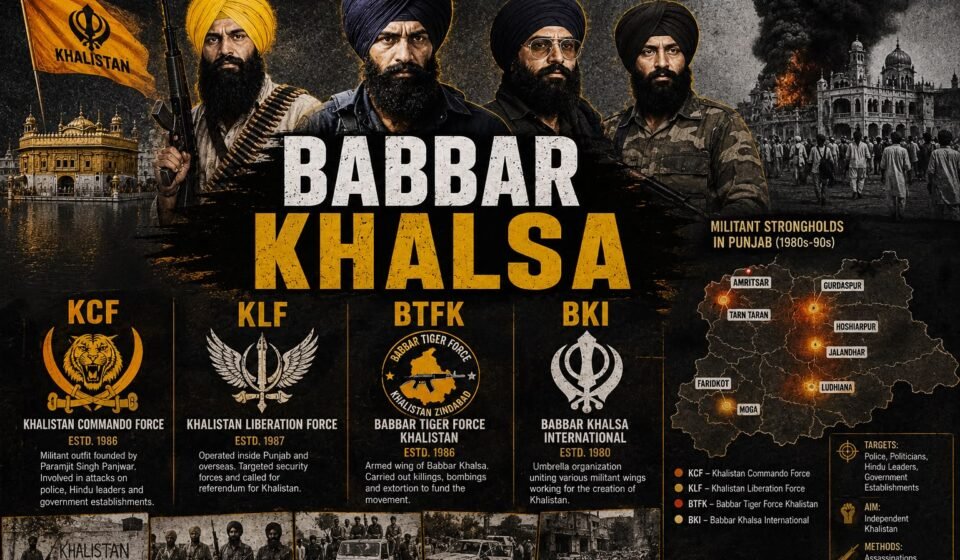
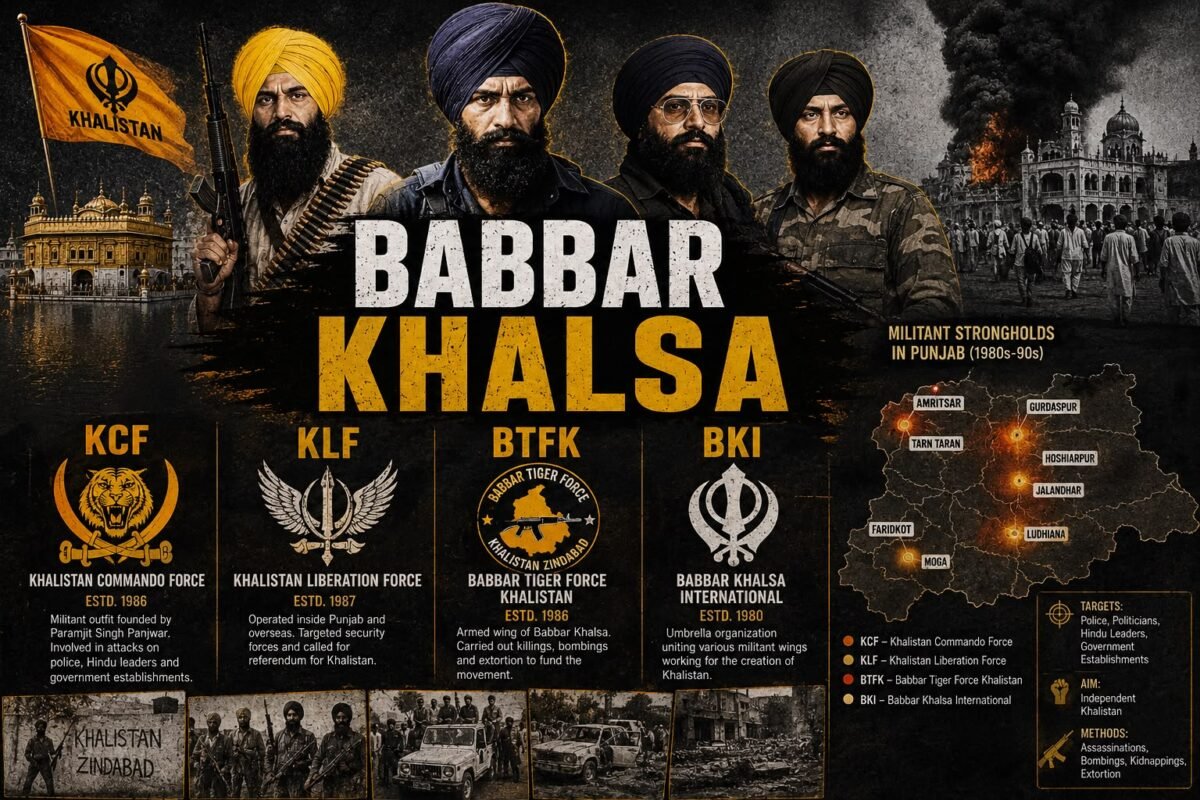
Outsiders spoke of the Punjab militancy as one thing. Punjab experienced it as many things, a shifting archipelago of armed groups, factions, and franchises that fought the state, cooperated with and betrayed one another, and competed for money, weapons, and the authority to speak for the Panth. Understanding the map of these organisations is essential to understanding the violence, because the groups differed genuinely in discipline and ideology, and because their multiplication explains why the killing became so uncontrollable.
Babbar Khalsa: The Oldest and Most Doctrinaire
Babbar Khalsa International traced its lineage to the Akhand Kirtani Jatha circles hit at the 1978 Nirankari clash, and it predated the general insurgency. Led for most of its existence by Talwinder Singh Parmar abroad and Sukhdev Singh Babbar within Punjab, it was the most religiously rigorous of the groups, enforcing strict rehat among cadres, and among the most internationally networked. Parmar was named by Canadian investigators as the architect of the Air India Kanishka bombing of 1985, the subject of a later article in this series, an atrocity that killed 329 people and remains aviation’s deadliest act of terrorism before 2001. Sukhdev Singh Babbar was killed by police in 1992; Parmar died in police custody in Punjab the same year, in circumstances officially described as an encounter and long disputed. Babbar Khalsa survives on international terrorism designations to the present day.
KCF: The Declared Army
The Khalistan Commando Force, proclaimed alongside the 1986 declaration of Khalistan, styled itself the movement’s regular army. Its most storied chief was Labh Singh, a former police constable, under whom the KCF claimed responsibility for high profile assassinations and for the campaign against the security apparatus. After his death in 1988 the force split along lineages, the Panjwar and Zaffarwal and other factions each retaining the name, with Paramjit Singh Panjwar running his faction from Pakistan for decades until his assassination in Lahore in 2023.
KLF and BTFK: The Second Wave
The Khalistan Liberation Force, founded by Aroor Singh’s associates and made famous under Avtar Singh Brahma and later Gurjant Singh Budhsinghwala, drew heavily on the Majha peasantry and was, in its Brahma period, reputed among villagers for a comparative discipline that later phases did not maintain. The Bhindranwale Tiger Force of Khalistan, raised by Gurbachan Singh Manochahal of the Panthic Committee, claimed the mantle of the sant’s name, and like the others eventually fractured. Alongside these four ran a long tail of smaller outfits and, in the insurgency’s last years, groups that were reported by police and journalists alike to be little more than armed extortion gangs flying a flag of convenience, as well as units penetrated or run by the intelligence agencies themselves, the notorious black cats, whose operations blurred the record of who killed whom in ways that still frustrate historians.
What the Map Explains
Three features of this landscape shaped the tragedy. First, fragmentation removed restraint: with no single command, no ceasefire could be negotiated and no atrocity disowned, since another faction always claimed the deed or the licence. Second, competition drove escalation, as groups proved their primacy through spectacular killings, including the bus massacres and market bombings this series documents, and through the taxation of the very population they claimed to defend, an extortion economy treated in a later article. Third, external patronage, principally the sanctuary and supply lines run from Pakistan, kept factions alive that Punjab’s own society had ceased to sustain, which is why the militancy’s final collapse, when it came in 1992 and 1993, was so swift once the population turned and the police campaign closed the space.
The men who led these groups are remembered in radical iconography as generals of a liberation war. The record this series assembles suggests a harder truth: whatever the first recruits believed they were fighting for, the organisational logic of the militancy, fragmentation, competition, extortion, and foreign dependency, guaranteed that its principal victims would be the Sikhs and Hindus of Punjab themselves. The map of the groups is, in the end, a map of that logic.
Related Reading
- The Killing Fields of Majha: Tarn Taran and Amritsar in the Late 1980s
- The Bus Massacres: When the Militancy Turned Its Guns on Passengers
- The Air India Kanishka Bombing: Terror Crosses the Ocean
Official context: Readers can compare this story with public information from India.gov.in.
The Descent
Part 6 of 10 in this chapter.