 In 30 Seconds




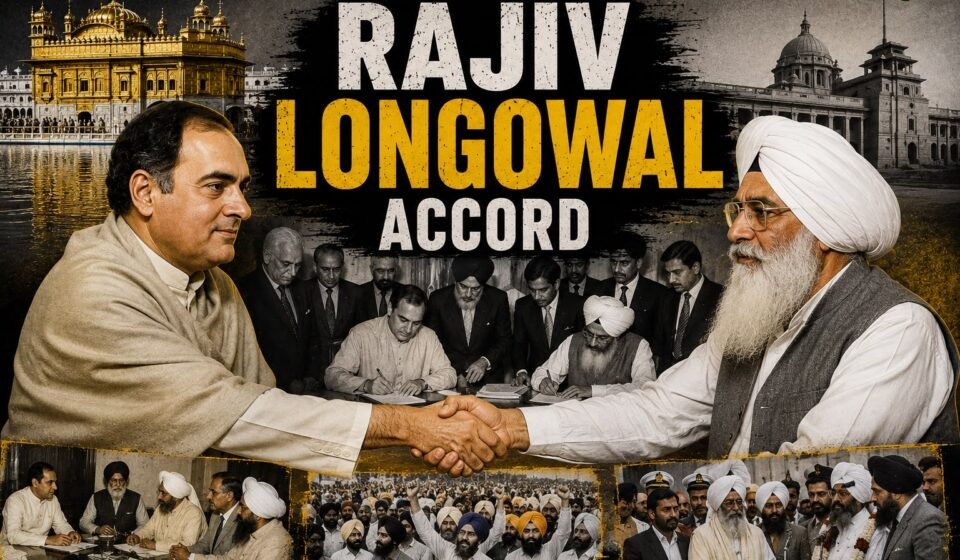
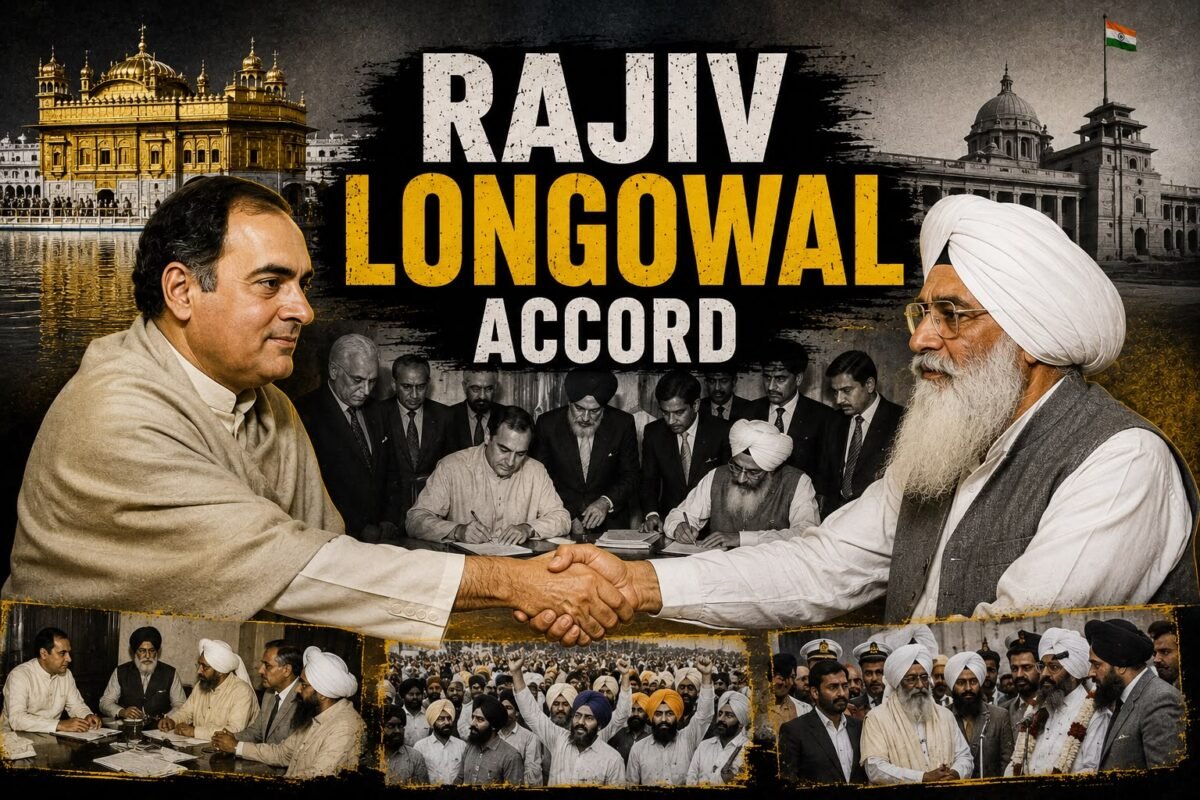
For one summer, it looked as if the Punjab tragedy might end early. In July 1985, Prime Minister Rajiv Gandhi and the Akali Dal president Sant Harchand Singh Longowal signed a memorandum of settlement that addressed, on paper, nearly every grievance this series has catalogued: Chandigarh, river waters, territorial claims, the army deserters of 1984, the demand for an inquiry into the November killings, and the federal questions of the Anandpur Sahib Resolution. The Punjab Accord was greeted with relief across most of India and much of Punjab. Within a month its Sikh signatory was dead, and within a few years nearly every clause had failed. How a signed peace dissolved is one of the era’s most instructive stories.
What the Accord Promised
The memorandum’s terms were concrete. Chandigarh would be transferred to Punjab on Republic Day 1986, with Haryana compensated by Hindi speaking territories to be identified by a commission. The river waters claims of Punjab, Haryana, and Rajasthan would be verified by a tribunal, which became the Eradi Tribunal. The Anandpur Sahib Resolution’s centre state demands would go to the Sarkaria Commission, an implicit concession that they were federal, not secessionist. Compensation would flow to victims of the November violence, and the jurisdiction of an inquiry, the Misra Commission, would extend beyond Delhi. Army deserters of 1984 would be rehabilitated. It was, in structure, everything the negotiations of 1982 to 1984 had failed to deliver before the tanks moved.
Why Longowal Signed, and What It Cost Him
Longowal, released from detention in 1985, made the calculation of a genuine moderate: that the community’s wounds could only be closed by settlement, and that someone must absorb the fury of signing. The hardline factions and the militant groups denounced the accord as a betrayal of the dead of June and November. On August 20, 1985, less than a month after the signing, Longowal was shot dead by militants while addressing a congregation at a gurdwara in Sherpur, Sangrur. His assassination, treated in full in the next article of this series, was the accord’s first casualty and its most prophetic.
The Unravelling
The elections of September 1985, held in Longowal’s shadow, produced an Akali government under Surjit Singh Barnala, the accord’s intended custodian. Then the clauses began to fail. Chandigarh was not transferred on Republic Day 1986; the commissions tasked with identifying compensating territory for Haryana could not square the map, deadlines lapsed, and the transfer was postponed indefinitely, where it remains four decades later. The Eradi Tribunal’s water findings satisfied no state and settled nothing, as recorded earlier in this series. The Barnala government fractured under militant pressure and internal splits, and after police again entered the Golden Temple complex in 1986, it lost its religious legitimacy in the eyes of much of its base. President’s rule returned in 1987, and Punjab passed into the bloodiest phase of the insurgency.
The Lesson of the Lost Peace
Analysts have distributed the blame widely, and the distribution is instructive. The Centre, having gained the political credit of signing, proved unwilling to pay the political price of implementing, particularly in Haryana, where elections loomed. The Akalis could not hold their flock against the charge of betrayal while the accord’s benefits failed to arrive. And the militants understood precisely what the accord threatened, which is why they killed its signatory: a settled Punjab had no need of them. Every party thus taught Punjab the same lesson from different directions, that moderation is fatal and agreements are paper.
The Rajiv Longowal Accord deserves to be remembered not as a failure of design but as a failure of nerve. Its terms, had they been executed, would have removed from the militancy’s hands nearly every grievance it traded on, years before the killing peaked. The peace was signed, celebrated, and then simply not performed. Punjab’s dead of 1986 to 1995, the majority of the insurgency’s entire toll, fell after the settlement that should have saved them was allowed to lapse. That arithmetic belongs in any honest reckoning of responsibility for what followed.
Related Reading
- The Killing Fields of Majha: Tarn Taran and Amritsar in the Late 1980s
- The Bus Massacres: When the Militancy Turned Its Guns on Passengers
- The Air India Kanishka Bombing: Terror Crosses the Ocean
Official context: Readers can compare this story with public information from India.gov.in.
The Descent
Part 3 of 10 in this chapter.