
 In 30 Seconds




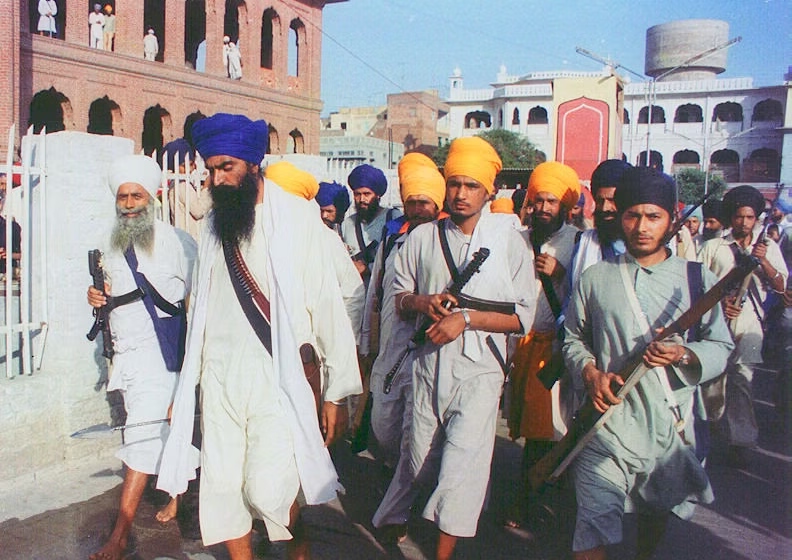
No figure in the Punjab tragedy divides memory as completely as Jarnail Singh Bhindranwale. To his followers, and to a substantial current of Sikh memory today, he was a sant, a revivalist preacher who armed his people against a hostile state and died a martyr defending the Akal Takht. To most of the Indian mainstream he was the architect of a terror campaign, a man from whose fortified headquarters inside the Golden Temple complex killings across Punjab were reported to have been directed. Any honest account has to hold both portraits up to the light.
From Rode to the Damdami Taksal
Born in 1947 in the village of Rode in Faridkot district, Jarnail Singh was the son of a farmer and joined the Damdami Taksal, a centuries old itinerant seminary, as a young man. He rose quickly, and in 1977 was chosen to head the Taksal after the death of his predecessor. His early mission was religious rather than political. Punjab’s prosperity had brought what revivalists saw as moral decay, alcohol, intoxicants, the trimming of beards, and Bhindranwale toured the villages baptising young men back into the discipline of the Khalsa. Contemporary accounts agree that he was a mesmerising village orator, austere in his own habits, and utterly certain of his cause.
The Turn to Confrontation
The 1978 Nirankari clash, covered earlier in this series, transformed him. The thirteen dead protesters became his cause, and the 1980 acquittal of the Nirankari chief became his proof that Sikhs could expect no justice from Indian institutions. As assassinations of Nirankaris and of critics followed, his name was linked in police investigations to a widening circle of violence, though it bears recording that he was never convicted of any of it. His arrest in 1981 in the Lala Jagat Narain murder case, and his swift release, taught Punjab a fatal lesson: the state either could not or would not hold him.
Journalists and politicians of the era have extensively documented the role of Congress politicians, including figures close to Sanjay Gandhi and later Giani Zail Singh, in initially promoting Bhindranwale as a counterweight to the Akali Dal. The strategy assumed the preacher could be used and discarded. Instead he outgrew every patron, turned on the Akalis and the Congress alike, and by 1982 had joined his campaign to the Akali Dharam Yudh Morcha, bringing his armed following into the centre of Sikh politics.
Inside the Complex
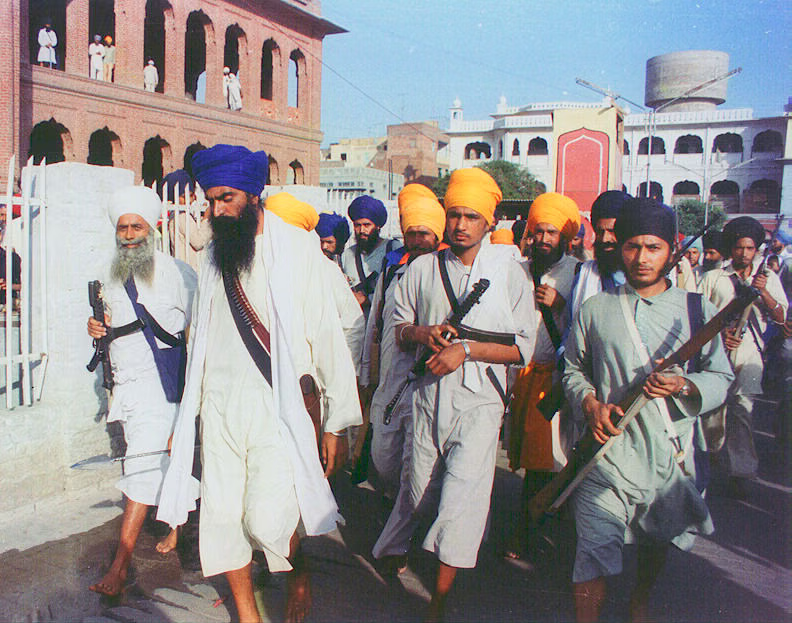
From 1982 Bhindranwale operated from within the Golden Temple complex, first from the Guru Nanak Niwas hostel and then, from December 1983, from inside the Akal Takht itself, the temporal seat of Sikh authority. Around him gathered armed men, including the former army officer Shabeg Singh, who fortified the complex against the assault everyone increasingly expected. Weapons are reported to have flowed in steadily. Killings across Punjab, of policemen, officials, Nirankaris, dissenting Sikhs, and Hindus, were attributed by investigators to men who moved in and out of the complex, and hit lists were widely reported. Bhindranwale’s own speeches from this period, many of them recorded and since studied by scholars, mix religious exhortation with open contempt for the government, warnings of a Hindu conspiracy against Sikhs, and statements about violence that his defenders read as conditional self defence and his critics read as incitement.
Asked whether he sought Khalistan, he gave the answer that still frames the debate: he said he neither supported it nor opposed it, but that if the government attacked the Darbar Sahib, the foundation of Khalistan would be laid. In June 1984 the government did exactly that, and the prophecy fulfilled itself.
Death and Afterlife
Bhindranwale was killed on June 6, 1984, in the army’s assault on the Akal Takht during Operation Blue Star, fighting alongside Shabeg Singh and his closest men. He was thirty seven. In death he became what the state could never manage to make him in life, a fixed and finished symbol. The Akal Takht’s custodians would in later years formally describe him as a martyr, and his portrait hangs today in the Sikh Museum inside the complex. For the families of those killed in the violence attributed to his movement, that veneration remains an open wound.
The historian’s verdict may be the only stable one available. Bhindranwale was made possible by real grievances and cynical politics, was elevated by men who thought they could control him, met a state that alternated between appeasement and overwhelming force, and left behind a Punjab in which more than twenty thousand people would die. He was, in the fullest sense, a storm, and storms are judged by what they leave behind.
Related Reading
- The Killing Fields of Majha: Tarn Taran and Amritsar in the Late 1980s
- The Bus Massacres: When the Militancy Turned Its Guns on Passengers
- The Air India Kanishka Bombing: Terror Crosses the Ocean
Official context: Readers can compare this story with public information from India.gov.in.
Origins and Escalation
Part 4 of 10 in this chapter.