

 In 30 Seconds




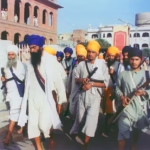
On April 13, 1978, the day of Baisakhi, two processions moved through Amritsar. One belonged to the Sant Nirankari Mission, a sect regarded by orthodox Sikhs as heretical for its veneration of a living guru. The other was a protest march of Sikhs, drawn from the Akhand Kirtani Jatha and the followers of a then little known preacher named Jarnail Singh Bhindranwale, determined to stop the Nirankari convention from taking place in the holy city. By the end of the day thirteen of the protesters and, by most accounts, at least two others lay dead, and Punjab had crossed a line it would not recross for nearly two decades.
What Happened That Day
Accounts of the clash have been contested from the first hour, but the broad sequence is reasonably settled in the reporting and judicial record of the time. The protest march approached the Nirankari gathering. A confrontation began, and gunfire came from the Nirankari side, whose members included armed followers of the sect’s chief, Gurbachan Singh. Thirteen protesters were killed. The dead were mourned across Sikh Punjab as martyrs who had fallen defending the faith inside its holiest city.
The aftermath deepened the wound. The criminal trial of the Nirankari chief and his co accused was transferred out of Punjab to Haryana, and in 1980 the court acquitted the accused, accepting the plea of self defence. To orthodox Sikh opinion the acquittal read as proof that the Indian state would not deliver justice for Sikh blood. Whether or not that reading was fair to the judicial process, its political effect was immediate and enormous.
The Making of a Confrontation
The clash did not come from nowhere. Tension between the orthodox Sikh tradition and the Sant Nirankari Mission had been building for years, fed by the sect’s practices and by what many Sikhs saw as official patronage of the mission as a counterweight to Akali politics. Journalists and scholars of the period have also documented how the confrontation elevated Bhindranwale, until then the young head of the Damdami Taksal seminary, into a figure of Panthic consequence. He had not led the march himself, but the dead included men who had answered the call he helped raise, and he took up the cause of avenging them with a single mindedness that would define the years to come.
The Cycle Begins
What followed the 1980 acquittal was the first sustained campaign of assassination in the Punjab tragedy. On April 24, 1980, Gurbachan Singh was shot dead in Delhi. The murder was celebrated in militant circles, and investigators linked it to men associated with the Bhindranwale circle and the Akhand Kirtani Jatha, though Bhindranwale himself was never convicted of any role. Killings of Nirankari followers continued across Punjab for years. In September 1981 came the murder of the newspaper magnate Lala Jagat Narain, whose papers had criticised Bhindranwale and defended the Nirankaris, an assassination examined in the next article of this series.
Each killing brought police cases, and each police case brought allegations of persecution, and each allegation swelled the crowds around the preacher. The state’s response oscillated between crackdown and accommodation. Bhindranwale was arrested in connection with the Jagat Narain case in 1981 and released within weeks, a release widely reported to have been eased by political calculation, and he emerged from custody larger than he had entered it.
Why Baisakhi 1978 Matters
Historians reach for different starting points for the Punjab insurgency, but 1978 has the strongest claim because it supplied every element of the machinery that later consumed the state. It provided martyrs and the demand for revenge. It provided a judicial outcome that could be framed as proof of state bias. It provided a leader whose authority rested on confrontation. And it established the precedent that disputes within and around the faith would be settled with weapons rather than words.
Thirteen deaths on a festival day were, by the grim standards of what came later, a small toll. More than twenty thousand people would die in the years that followed. But every one of those later deaths stands in a line that runs back to Baisakhi 1978, the day the fuse was lit and no one in authority, in Amritsar, Chandigarh, or Delhi, moved seriously to stamp it out.
Related Reading
- The Killing Fields of Majha: Tarn Taran and Amritsar in the Late 1980s
- The Bus Massacres: When the Militancy Turned Its Guns on Passengers
- The Air India Kanishka Bombing: Terror Crosses the Ocean
Official context: Readers can compare this story with public information from India.gov.in.
Origins and Escalation
Part 3 of 10 in this chapter.