 In 30 Seconds




Every insurgency has a date on which the first shot was fired, and a much longer story about why the gun was loaded at all. In Punjab the shooting is usually dated to the late 1970s and early 1980s, but the loading of the gun took decades. To understand the violence that consumed the state between roughly 1980 and 1995, one has to begin with the peculiar mixture of prosperity, anxiety, and political grievance that defined Punjab after independence.
Punjab entered independent India carrying the deepest wound of Partition. The province was cut in two in 1947, and the violence of that division fell on Punjabis, Sikh, Hindu, and Muslim alike, with a ferocity that left millions displaced and hundreds of thousands dead. The Sikh community, whose historic homeland and holiest institutions straddled the new border, absorbed a demographic and psychological shock whose effects would echo for generations. The community rebuilt with remarkable speed, but a memory of vulnerability, of being a small minority in a vast country, settled into its political imagination.
Language, Statehood and the First Grievances
The first great postwar political battle was over language. The Akali Dal, the principal Sikh political party, campaigned through the 1950s and early 1960s for a Punjabi speaking state, a demand the central government long resisted, in part because it was seen as a religious demand wearing linguistic clothes. When the Punjabi Suba was finally conceded in 1966, it arrived in a form that itself generated new grievances. The new Punjab was smaller than the Akalis had hoped. Chandigarh, the capital built for the old undivided state, was made a shared union territory rather than being given to Punjab. Certain Punjabi speaking areas went to Haryana and Himachal Pradesh. Control over river waters, the lifeblood of an agricultural state, remained substantially with the Centre and was shared with neighbours in ways Punjab regarded as unjust.
Each of these issues, Chandigarh, territory, and water, would remain unresolved for decades, and each would appear again in the Anandpur Sahib Resolution and in the rhetoric of the militancy. Grievances that might have been settled as administrative disputes in the 1960s hardened into symbols of a community’s alleged mistreatment.
The Green Revolution’s Double Edge
Meanwhile the state was transformed economically. The Green Revolution of the late 1960s and 1970s made Punjab the granary of India and its farmers among the most prosperous in the country. But prosperity had a double edge. Mechanisation reduced the need for labour on family farms just as a generation of rural young men, better educated than their fathers, came of age with few industrial jobs to absorb them. Landholdings fragmented with each generation. Scholars of the period have argued that this pool of underemployed, ambitious rural youth became the recruiting ground first of religious revivalism and later of militancy.
Religion, Politics and the Akali Congress Duel
The political system compounded the pressure. Punjab politics revolved around a duel between the Akali Dal and the Congress, and both parties played with religious mobilisation. The Akalis, whose base was the Sikh peasantry, framed secular demands in religious idiom because that was the language that moved their voters. The Congress, for its part, is widely reported by journalists and scholars of the period to have encouraged religious hardliners in the late 1970s as a way of splitting the Akali vote, a gambit that would later be remembered as one of the most catastrophic miscalculations in Indian political history.
Into this combustible mixture stepped a young preacher from the Damdami Taksal named Jarnail Singh Bhindranwale, whose rise is the subject of a separate article in this series. The clash between his followers and the Nirankari sect at Amritsar in April 1978, in which thirteen Sikhs were killed, is often treated as the spark. But a spark only matters when it lands on dry tinder, and by 1978 Punjab had been drying for thirty years.
What Followed
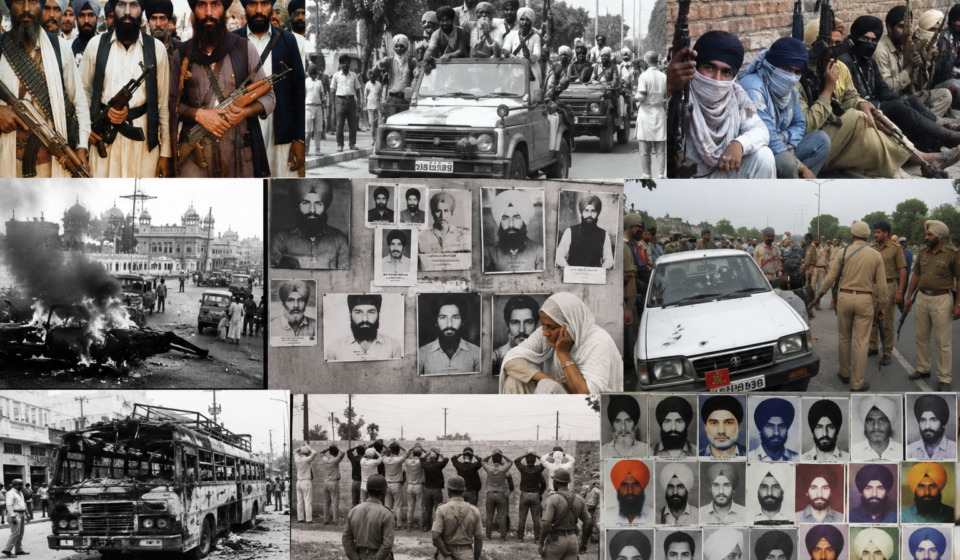
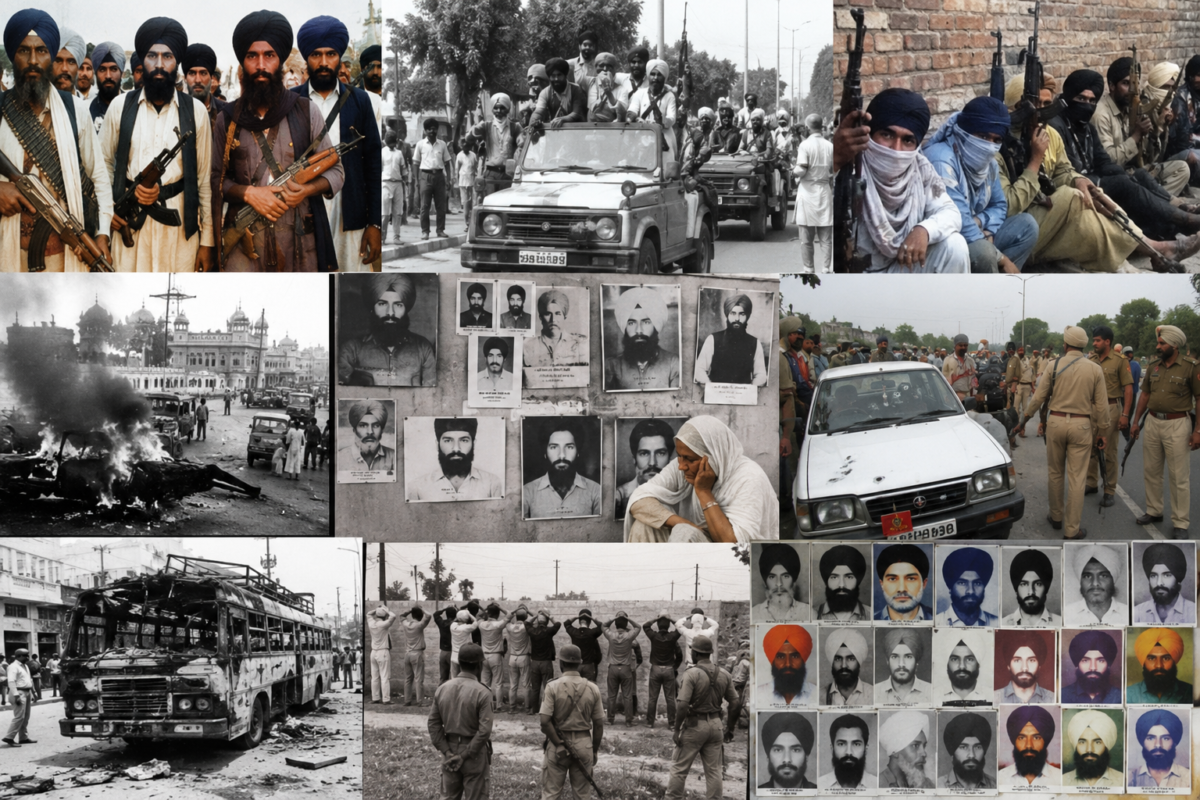
Between 1980 and 1995, by official counts, the violence in Punjab killed more than twenty thousand people, with some assessments placing the figure considerably higher once disappearances and unrecorded deaths are considered. The dead included civilians of every faith, police personnel, and militants. The state saw the storming of the Golden Temple complex by the army in 1984, the assassination of a prime minister, an anti Sikh pogrom in the national capital, a decade of targeted killings and massacres, and a police campaign whose methods remain the subject of human rights litigation to this day.
None of it was inevitable. That is perhaps the most important truth about the roots of the storm. At nearly every stage there were exits, accords offered and abandoned, moderate leaders available and undermined, demands that were negotiable treated as treasonous, and treasonous violence treated, for too long, as negotiable. The articles that follow in this series trace that descent step by step, from the Anandpur Sahib Resolution to the last gasp of the militancy in 1995, with the aim of recording what happened to all of Punjab’s people, without flinching and without favour.
Related Reading
- The Killing Fields of Majha: Tarn Taran and Amritsar in the Late 1980s
- The Bus Massacres: When the Militancy Turned Its Guns on Passengers
- The Air India Kanishka Bombing: Terror Crosses the Ocean
Official context: Readers can compare this story with public information from India.gov.in.
Origins and Escalation
Part 1 of 10 in this chapter.